Collaborating with Fishing Communities to Adapt:
Co-Developing Actionable Strategies for Atlantic Sea Scallop Fishing Communities
GENERAL DESCRIPTION:
Atlantic sea scallop habitat is changing as New England waters warm, freshen, and become lower in oxygen and pH (ocean acidification). In the Northeast U.S., the contribution of sea scallops to the region's total landed value has steadily increased in recent decades. While historically resilient to ocean changes, sea scallops are increasingly vulnerable to ocean acidification and ocean warming, which impact growth and reproduction. Recent extreme temperature events have resulted in mortality, highlighting the need for improved forecasting and adaptive management strategies. However, current management approaches do not sufficiently incorporate environmental data, limiting the industry’s ability to proactively respond to forecastable extreme events.
The growing reliance on the Atlantic sea scallop fishery, along with the predicted shift in sea scallop distribution and the decline in biomass, requires scientists, stakeholders, and managers to work together to develop management strategies that address these regional changes. We recently collaborated on a project to assess the vulnerability of the sea scallop social-ecological system. Now, we are collaborating on a follow-up project that will work with fishermen to co-develop forecasting tools and actionable adaptive management strategies.
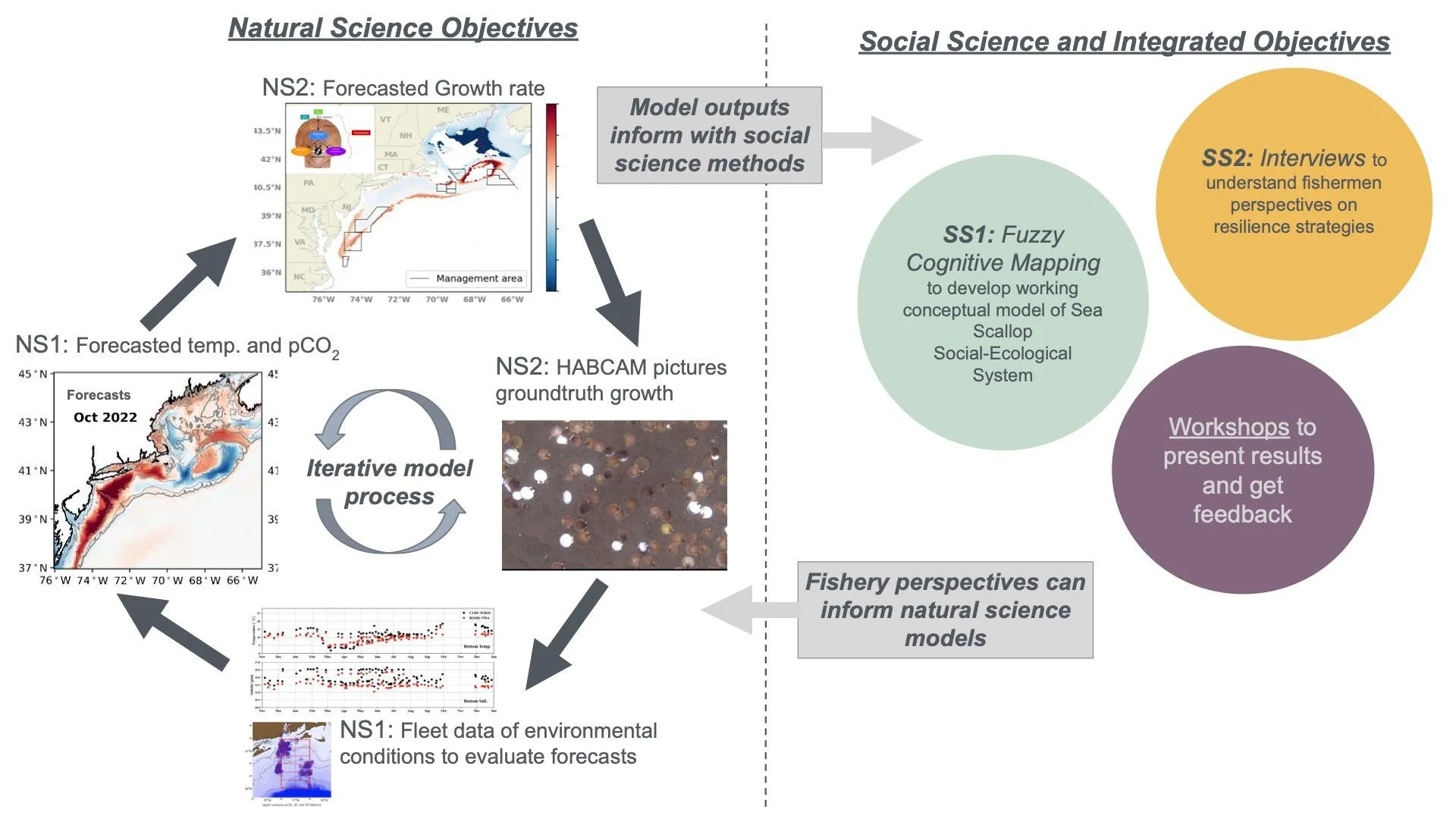
This project, led by the University of Connecticut, aims to enhance the adaptive capacity of the sea scallop fishery to respond to changing ocean conditions by integrating oceanographic modeling, industry involvement, and social science research into actionable management strategies. The project emphasizes close collaboration with industry stakeholders through workshops and interviews. Fishermen will work with the project team to help improve and co-develop forecast models. These actions may increase flexibility in the management process, which is necessary for the fishery to build climate resilience. CFRF’s role in this project is to organize, host, and evaluate regional industry workshops and to prepare informative brochures.
Overall PROJECT GOALS:
Develop and evaluate seasonal forecasts of subsurface ocean conditions such as temperature, oxygen, and pCO2.
Use a Dynamic Energy Budget model to seasonally forecast Sea Scallop growth and mortality within
rotational management areas.
Construct a conceptual model of the Sea Scallop fishery’s social-ecological system using Fuzzy Cognitive Mapping to identify vulnerabilities and potential adaptation strategies.
Investigate whether involving fishermen in data collection increases trust in scientific models and improves decision-making.
Test resilience strategies co-developed with the fishing industry.
CFRF Objectives:
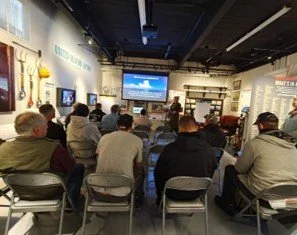
Organize and evaluate annual workshops between scientific partners and the fishing community at select regional fishing ports.
Produce and distribute project brochures.
Integrate project results into CFRF community outreach.
PROJECT TEAM:
NOAA National Marine Fisheries Service
Shannon Meseck
Dvora Hart
Robert Murphy Jr.
Rutgers University
Enrique Curchitser
University of Maryland
James LaChance
Commercial Fisheries Research Foundation
Susan Inglis - CFRF Project Lead
N. David Bethoney
University of Connecticut - Lead Institution
Samantha Siedlecki
Catherine Matassa
Project Outreach
CFRF will organize up to four workshops each project year that facilitate discussions of project goals, approaches, and preliminary and final results while addressing industry concerns and supporting the collaborative design of forecast products. The brochures will include information graphics explaining how changing ocean conditions may impact commercial fishing, the vulnerabilities of the regional fishing community, and practical management strategies to mitigate these impacts. The first brochure will be produced in year 1, focusing on introducing the project and how fishermen can get involved. The second brochure will be produced in year 2, focusing on the initial results and the implications for the fishing industry. The final brochure will summarize project results.
THIS PROJECT iS SUPPORTED BY:
The National Oceanic and Atmospheric Administration’s Ocean Acidification Program